BRYCE DELPLANQUE: WHAT IS LOST IS ALREADY ON THE WALL
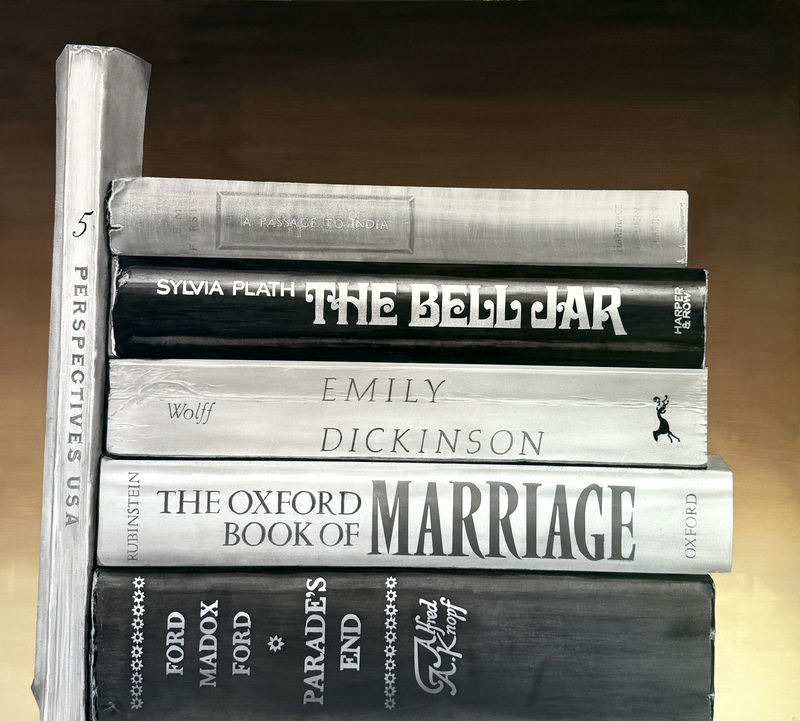
What is lost is already on the wall is a tribute by Bryce Delplanque to Joan Didion, a major figure in American literature whose precise and incisive writing profoundly shaped contemporary ways of seeing. The project takes as its point of departure the auction of Didion’s personal belongings, dispersed following her death in December 2023: her annotated library, furniture, notebooks, and personal effects.
These objects were photographed, catalogued, described. Their status shifted. What once belonged to use now belongs to reading. They no longer exist solely for what they were, but for what they reveal. Removed from their original context, they become images. Bryce Delplanque works from this shift without attempting to reconstruct intimacy or produce an archive. He observes what these objects have become once detached from their function: surfaces of projection, available signs, autonomous images.
Joan Didion wrote: “See enough and write it down […] I will simply open my notebook and there it will all be […] Remember what it was to be me: that is always the point.” For her, writing meant fixing a position. Not preserving facts, but preserving a way of seeing. The notebook was not a record of events but an instrument of clarity. Her work is marked by a sustained attention to the visible forms of existence: interiors, clothing, places, objects, habits. What we call lifestyle was never merely decorative. As Don DeLillo wrote in White Noise, “Californians invented the concept of lifestyle.” Didion revealed its underlying structure. These material elements organize perception and give form to identity, to a system of beliefs.
It is at this level that Delplanque’s work finds its coherence. While the project emerges from a deep admiration for Didion, it does not represent these objects for their sentimental value alone. He approaches them as elements within a structure. Each image becomes the trace of a construction. Developed in series, his work consists of taking an image, displacing it, repeating it, testing its stability. He examines what remains once context falls away, and what persists.
The series of sunglasses, emblematic of the writer, functions as a narrative device. Each frame, presented at large scale, contains a different charcoal landscape: a Californian beach, a view of Sacramento, a motel. These places refer to the territories Didion inhabited and wrote about, yet their association is not documentary. Delplanque selects these correspondences and composes a possible narrative. The same tension runs through the book series. Some stacks are grouped by author, others by theme: love, marriage, cooking. Do these arrangements reflect Didion’s own order, or were they imposed later, through the logic of the auction? The question matters less than the gesture itself. What is presented is an organizational hypothesis.
In both cases, Delplanque embraces interpretation. The associations he constructs introduce a distance between the document and the image. This distance is deliberate. Didion was wary of the illusion of objectivity. She understood that writing meant organizing reality from a specific position. Delplanque operates according to a comparable logic. He assembles existing fragments and arranges them in series. The work does not restore a life, but reveals its visible structure.
Didion also wrote: “I write entirely to find out what I'm thinking, what I'm looking at, what I see and what it means.” Delplanque paints according to the same principle - not to illustrate what he already knows, but to understand what he is looking at. The image becomes an instrument of inquiry rather than the transcription of a prior idea. This shared method ultimately holds the entire project together.
A portion of this body of work was presented at POCTB Art Center in Orléans from March 5 to April 5, 2026. At Prima, the exhibition unfolds in an expanded form, extending an ongoing dialogue between the gallery and the artist since its opening, and affirming the continuity of a rigorously developed practice.


